A game art direction study
Monochrome and one-bit game art
Monochrome game art removes hue as a way to separate objects, making value, silhouette and texture more important. Return of the Obra Dinn and LIMBO solve that problem differently: a dense two-tone drawing and a layered silhouette scene. One-bit and grayscale are related choices, not interchangeable descriptions.
Artstyle visual analysis of the screenshots below. These references describe appearance, not a verified account of how the original assets were produced.
Explore monochrome referencesWhat defines this look
Value structure
Decide which objects belong to the darkest and lightest groups before working on small details. A silhouette needs a contrasting area behind it to remain recognizable.
Texture frequency
Dithered or hatched marks can suggest intermediate tones, but their density must differ between adjacent surfaces. Similar patterns on everything flatten the scene.
Depth without hue
Overlap, atmospheric contrast and changing detail can separate distance layers. A restricted palette does not remove the need for depth cues.
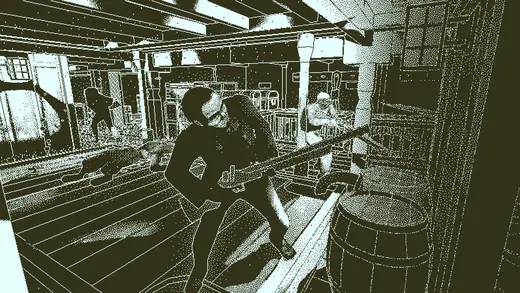
Dense two-tone description
Return of the Obra Dinn
Return of the Obra Dinn describes bodies, rigging and wooden surfaces with bright contours and dense monochrome patterns. Different mark densities help divide a crowded deck.
What to studyCompare the pattern inside a figure with the background immediately behind it.
Explore these references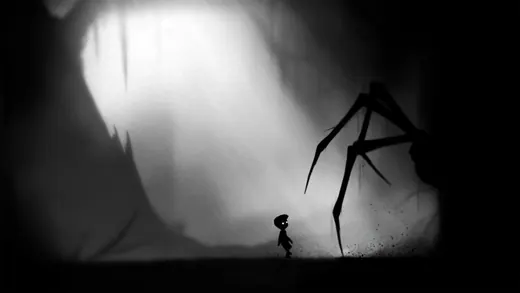
A silhouette hierarchy
LIMBO
LIMBO places small black shapes against pale mist and softened forest layers. Fine surface information gives way to the scale relationship between the child and spider.
What to studyRead the scene as three large value groups.
Explore these referencesWhat to avoid
A grayscale filter does not guarantee a good monochrome composition. If objects were separated only by hue, they may merge. Revisit value relationships and object boundaries.
Is one-bit art always black and white?
A one-bit image uses two possible values per pixel, but the displayed pair can be tinted. Grayscale art can use many intermediate values and requires a different texture strategy.
Build your reference sheet.
Build a sheet with silhouettes, texture patterns and distant layers. Specify whether your target is two tones, a small fixed palette or continuous grayscale.
Start a free lookbookYour free lookbook includes 20 references and sharing.
Visual analysis by Artstyle. Screenshots belong to their respective rights holders and are provided as references, not licensed production assets. Source links appear with each image.
Related visual studies
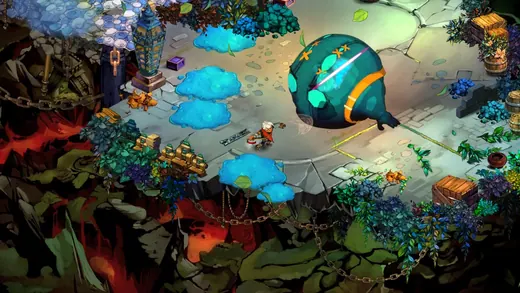
Painterly game art
Explore painterly game art in Hades, Bastion and Disco Elysium. Compare screenshots and collect references for illustrated environments and characters.
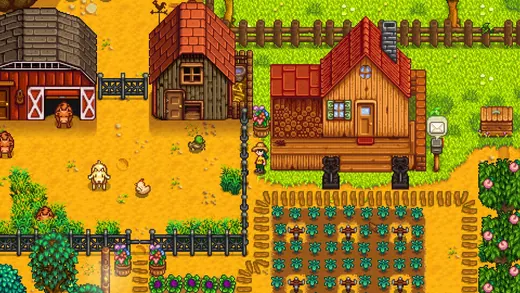
Pixel art game references
Compare pixel art in Stardew Valley, Fields of Mistria and Hyper Light Drifter. Explore palettes, object readability and environments for your game lookbook.
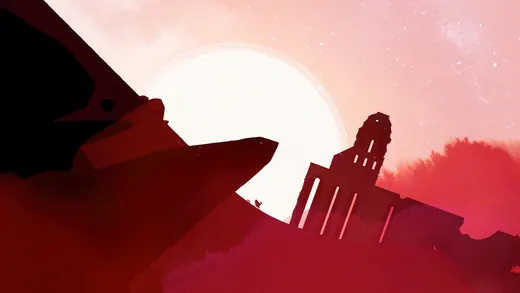
Watercolor game environments
Watercolor game environments use translucent-looking color, irregular edges and areas of visual quiet to suggest pigment on paper.